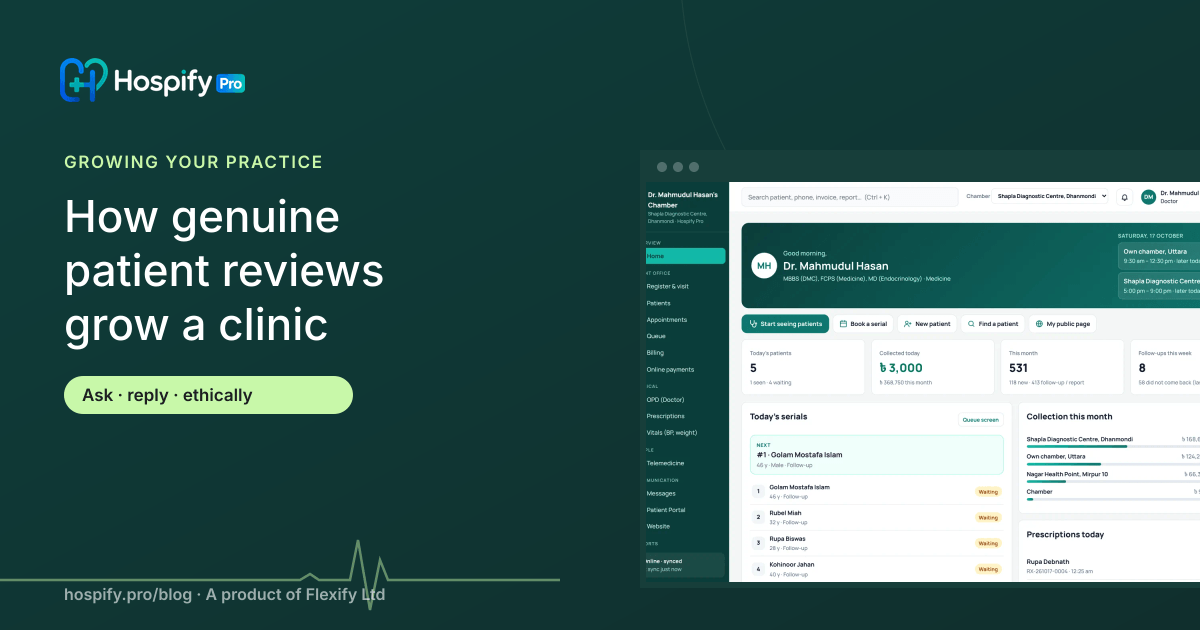
Online reviews are how patients judge a clinic before they visit: most read them, and they trust a steady stream of recent, genuine reviews with polite replies. The ethical way to get more is simple — ask every patient after a finished visit, make it one tap to leave a review, never pay or reward reviews, and reply to every review without revealing patient details.
In this guide 6 sections
Two diagnostic centres on the same road. Same machines, similar prices, both open late. One shows 4.7 stars from 200+ reviews, with a polite reply under each. The other has six reviews from three years ago and no replies. Which one does a worried parent call at 9 pm?
Reviews have become the word-of-mouth of the smartphone age. This guide explains why they matter so much for healthcare, and how to grow them without cutting ethical corners.
Why reviews decide so many choices
Patients cannot judge a doctor’s skill in advance, so they look for signals from people like them. In a US survey of 1,438 patients, 77% said they read online reviews when choosing a new physician. BrightLocal’s 2025 consumer survey found that only 4% of people never read reviews of local businesses.
Reviews also affect whether you are seen. Google’s local results consider how well known and well regarded a business is, and review count and rating are part of that picture. More genuine reviews tend to mean more visibility, which brings more patients, who leave more reviews. It is a loop that works for you once it starts.
What patients actually look at
- The rating — but also how many reviews it is based on.
- How recent the latest reviews are. Old reviews suggest a quiet clinic.
- What people mention — waiting time, staff behaviour, cleanliness, how reports were delivered.
- How you reply — especially to complaints.
How to get more reviews, ethically
- Ask every patient, the same way. Not only the ones you expect to be happy. Selective asking distorts your rating and breaks platform rules.
- Ask at the right moment — after the visit is finished and the patient has their prescription or report, not at the payment counter.
- Make it one tap. A short SMS with a direct link to your Google review page works far better than “please review us on Google”.
- Keep it polite and optional. “Thank you for visiting. If you have a moment, your feedback helps other patients” is enough.
- Never pay, reward or write reviews. No discounts, no gifts, no staff writing reviews from their phones. It is dishonest, it breaks Google’s rules, and it goes against the BMDC code of medical ethics.
How to reply — especially to bad reviews
Every clinic receives some negative reviews. Future patients read your reply more carefully than the complaint itself. BrightLocal found that 88% of people would use a business that replies to all its reviews.
A good reply to a complaint:
- Thanks the person for the feedback.
- Apologises for their experience, without arguing.
- Never confirms they are a patient or mentions any medical detail.
- Invites them to contact the clinic manager directly, with a number.
- Is short — three or four sentences.
“Thank you for sharing this. We’re sorry the waiting time was longer than expected. We’d like to understand what happened — please call our manager on 01XXX-XXXXXX so we can help.”
Reply to positive reviews too, briefly and warmly. It shows a clinic that listens.
Turning reviews into a habit
The clinics with the strongest reputations don’t run a review campaign once a year. They ask every patient, every day, and reply every week. That is hard to do by hand on a busy evening — which is why it works best when it is automatic.
With Hospify Pro, the review booster sends one polite SMS with your review link when a visit is finished — once per patient every 90 days, from your own SMS credits. Our team then drafts replies for you as part of Google profile management.
Want to see where you stand today? Get a free Google profile check — including your rating, review count and how you compare with clinics nearby.
Frequently asked questions
Is it allowed to ask patients for a Google review?
Yes. Asking is allowed and normal. What is not allowed is buying reviews, writing them yourself, offering discounts or gifts for them, or asking only the patients you expect to be happy. Ask everyone, the same way.
Should we delete or hide negative reviews?
You cannot delete genuine reviews, and trying usually backfires. You can report reviews that are fake or break Google's rules. For real complaints, a calm public reply and an offer to talk privately shows every future reader that you take care seriously.
Can we reply to a review with the patient's diagnosis or visit details?
No. Never confirm that someone is a patient, and never mention diagnoses, tests or treatment in a public reply. Thank them, apologise for the experience, and invite them to contact the clinic directly.
How many reviews does a clinic need?
There is no fixed number. What matters is having more recent, genuine reviews than the clinics you compete with in your area, and a steady flow every month rather than a burst once a year.

Hospify Pro is built by Flexify Ltd for hospitals, diagnostic centres, clinics, doctors and pharmacies in Bangladesh and beyond. Our guides come from the questions owners and managers ask us every week. About us