Quote a dental treatment plan tooth by tooth: show what you found on the chart, split the work into phases (urgent first, then restoring, then optional), price every procedure on each tooth, show the number of sittings and a total for each phase, put real alternatives side by side, say what could change the price, and agree how payment works per sitting. Then give the patient the plan in writing. A clear written plan avoids surprise bills and makes it easier for the patient to decide.
In this guide 12 sections
- 1. Start from the chart, tooth by tooth
- 2. Split the work into phases by urgency
- 3. Put a price on every procedure, for every tooth
- 4. Show the sittings, not only the money
- 5. Offer real alternatives side by side
- 6. Say what could change the price
- 7. Agree how payment works
- 8. Give the plan in writing
- A worked example
- How Hospify Pro’s dental chamber handles this
- Checklist before the patient leaves
- Frequently asked questions
Most dental treatment is not decided in the chair. It is decided at home, when the patient tries to explain to the family what the dentist said and what it will cost. If the plan was a quick verbal list and one round number, that conversation usually ends with “let’s wait”.
A clear quote does not push anyone. It simply lets the patient understand what is wrong, what you propose, what each part costs and what happens if they wait. This guide shows a simple way to build and explain one.
1. Start from the chart, tooth by tooth
Before talking about money, show the patient what you found. Use the tooth chart and go through it in plain words:
- 16: deep caries reaching the nerve, pain on biting.
- 26: old filling broken, decay underneath.
- 36: missing, extracted two years ago.
- Upper and lower front teeth: calculus and bleeding gums.
Use the numbering your chart uses (most dentists in Bangladesh use FDI two-digit numbers such as 16 and 36) and point to the tooth on the chart or the X-ray. When the patient can see the problem, the plan that follows makes sense.
2. Split the work into phases by urgency
A long list of procedures looks like one big bill. The same work split into phases looks like a plan.
| Phase | What goes in it | Example |
|---|---|---|
| 1. Urgent | Pain, infection, broken teeth, anything that gets worse quickly | Root canal on 16, scaling |
| 2. Restore | Saving teeth that can be saved | Crown on 16 after the root canal, new filling on 26 |
| 3. Replace or improve | Missing teeth, cosmetic work, orthodontics | Bridge or implant for 36 |
The patient can agree to phase 1 today and plan phases 2 and 3 for later. That is much easier than saying yes to everything at once.
3. Put a price on every procedure, for every tooth
Write each procedure on its own line with the tooth number and the price. Then show a total for each phase and a grand total.
A line-by-line plan tells the patient exactly what they are paying for. It also stops the common argument at the counter later: “the doctor said it would be less”. If the price is written next to the tooth, nobody has to remember.
4. Show the sittings, not only the money
Patients plan their time as much as their money. Tell them how many visits each part needs and roughly how far apart:
- Root canal: often two or three sittings, then the crown.
- Crown: preparation and impression, then fitting.
- Scaling: one sitting.
Write the next sitting on the prescription, for example “RCT 16, sitting 2 of 3”. The patient leaves knowing when to come back and why.
5. Offer real alternatives side by side
When more than one option is clinically acceptable, show them together with their prices and what each means over time:
- Root canal with a crown, or extraction (and later a bridge or implant to fill the gap).
- Metal-ceramic crown or full ceramic crown.
- Bridge or implant for a missing tooth.
Explain the trade-off honestly, including what happens if they choose the cheaper option or do nothing. Then let the patient decide. Being open about options builds trust; hiding them looks like selling.
6. Say what could change the price
Some things are only known once treatment starts. Say them in advance:
- A calcified or curved canal may need more time or an extra X-ray.
- A tooth may turn out not to be saveable after the old filling is removed.
- Lab charges for crowns and bridges depend on the material chosen.
A sentence like “if the canal is blocked, there may be an extra charge for one more X-ray” prevents an unpleasant surprise later.
7. Agree how payment works
Make the payment plan as clear as the treatment plan. Common ways are to pay for each procedure on the day it is done, or to pay an agreed part before a crown or bridge goes to the lab. Whatever you choose, write it down. When the patient pays each sitting, the bill should show the work done that day and what is still planned.
8. Give the plan in writing
A printed plan is what the patient shows the family. It should have:
- The patient’s name and date.
- The findings and procedure for each tooth.
- The price of each procedure, phase totals and the grand total.
- The alternatives discussed, with their prices.
- The next sitting.
- Your name, chamber and contact number.
Keep a copy in the patient’s record so that the next sitting starts from the same plan.
A worked example
Example only. Your own fees, materials and clinical judgement will differ.
| Tooth | Procedure | Phase | Sittings | Price (example) |
|---|---|---|---|---|
| 16 | Root canal treatment | 1 | 3 | Tk 8,000 |
| All | Scaling and polishing | 1 | 1 | Tk 1,500 |
| 16 | Metal-ceramic crown | 2 | 2 | Tk 6,000 |
| 26 | Composite filling | 2 | 1 | Tk 2,000 |
| 36 | Implant (option A) or bridge (option B) | 3 | several | Quoted separately |
Phase 1 total: Tk 9,500. Phase 2 total: Tk 8,000. Phase 3: two options, priced separately so the patient can compare.
Said this way, the patient hears “Tk 9,500 now to stop the pain and save the tooth, Tk 8,000 later to finish it”, not “Tk 17,500 plus an implant”.
How Hospify Pro’s dental chamber handles this
Hospify Pro’s dental chamber is built around the same steps:
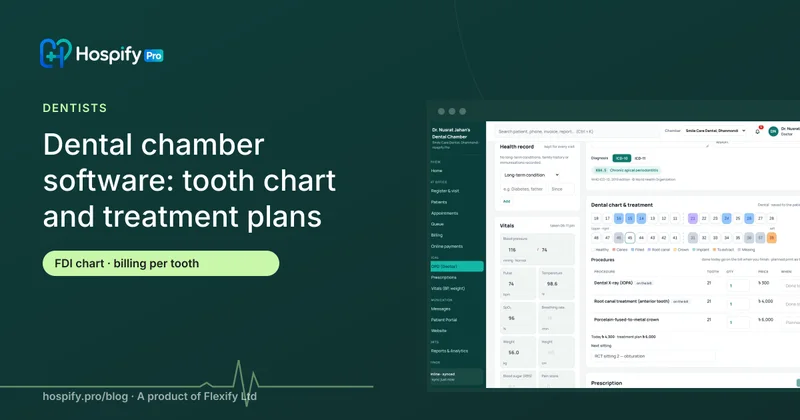
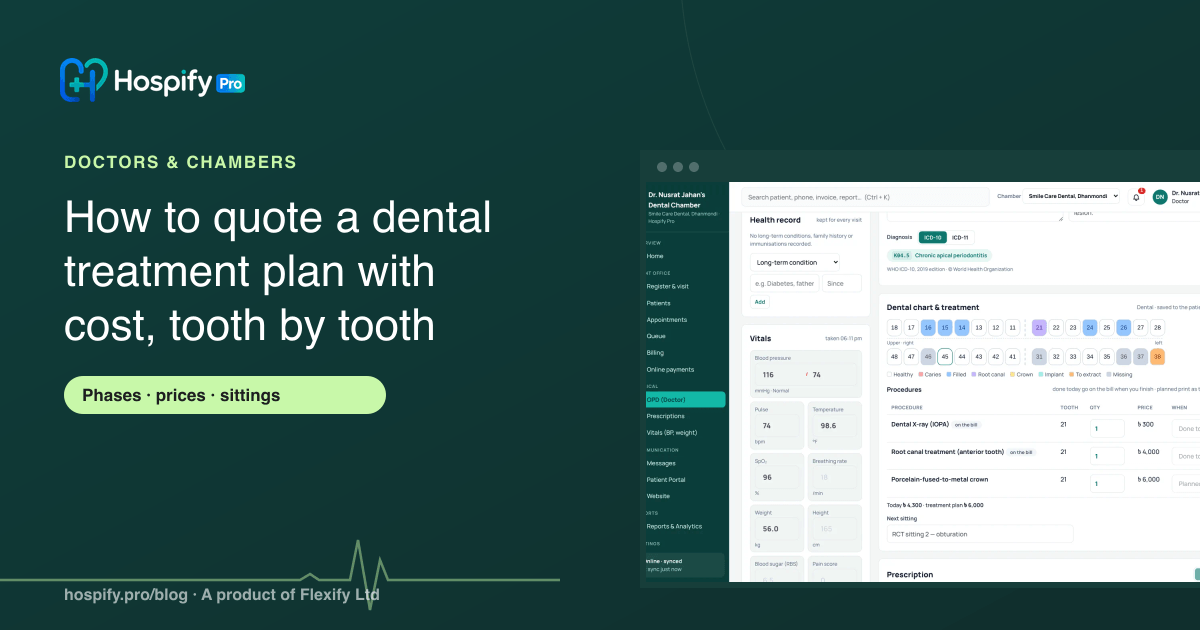
- The dentist marks teeth on an FDI tooth chart on the prescription screen.
- Procedures are added per tooth from your own price list, and each one is marked Done today or Planned.
- Work done today goes straight to the bill when the visit is finished, with no retyping at the counter.
- Planned work prints on the prescription as the treatment plan with the price of each item, and the screen shows today’s total and the plan’s total.
- The next sitting prints on the prescription, for example “RCT sitting 2 of 3, obturation”.
- The chart and planned work stay on the patient’s record for the next visit.
- When the patient says yes to a bigger plan — an implant, veneers, aligners, an RCT with a crown — you start a treatment case from it: the stages with dates, the package paid in instalments, the consent signed on a tablet, the lab orders and the implant record. Each instalment receipt shows what is paid and what is still due, and the patient sees the same plan in their portal.
- Plans that were priced but never started stay in Estimates not started, with a log of each follow-up call.
It is part of the Chamber plan at Tk 1,499 a month$24.99 a month, with a 14-day free trial. You can try it on the live dental demo, which has sample patients, tooth charts and treatment plans. For the wider picture, read our guide to dental chamber software in Bangladesh.
Checklist before the patient leaves
- Findings explained on the chart or X-ray, tooth by tooth.
- Work split into phases, urgent first.
- Price for every procedure on every tooth, with phase totals.
- Number of sittings for each part.
- Alternatives shown with their prices.
- What could change the price, said in advance.
- Payment agreed and written down.
- Printed plan handed over, copy kept in the record.
- Next sitting written on the prescription.
Frequently asked questions
What should a dental treatment plan include?
The findings on each tooth, the procedure planned for each tooth, the price of each procedure, the order of work in phases, the number of sittings, a total per phase and a grand total, any alternatives with their own price, what could change the cost, and how payment works. It should be given to the patient in writing.
Should I give the patient one total or a price for each tooth?
Both. A price per procedure on each tooth shows exactly what the patient is paying for, and the phase totals and grand total show the full commitment. Patients are more likely to doubt a single lump sum they cannot check.
How do I explain a big treatment plan without scaring the patient?
Split it into phases. Phase 1 is what must be done now (pain, infection, broken teeth). Phase 2 restores the teeth that are worth saving. Phase 3 is optional, such as replacing missing teeth or cosmetic work. The patient can agree to phase 1 today and plan the rest.
Should I mention cheaper alternatives?
Yes, when they are clinically acceptable. For example, a root canal with a crown versus extraction, or a metal-ceramic crown versus a full ceramic one. Show each option with its price, number of sittings and what it means for the patient over time, and let the patient choose.
Can dental chamber software print a treatment plan with cost?
Hospify Pro's dental chamber does. The dentist marks teeth on an FDI chart and adds procedures per tooth. Work done today goes straight to the bill, and planned work prints on the prescription as the treatment plan with the price of each item, along with the next sitting.

Hospify Pro is built by Flexify Ltd for hospitals, diagnostic centres, clinics, doctors and pharmacies in Bangladesh and beyond. Our guides come from the questions owners and managers ask us every week. About us