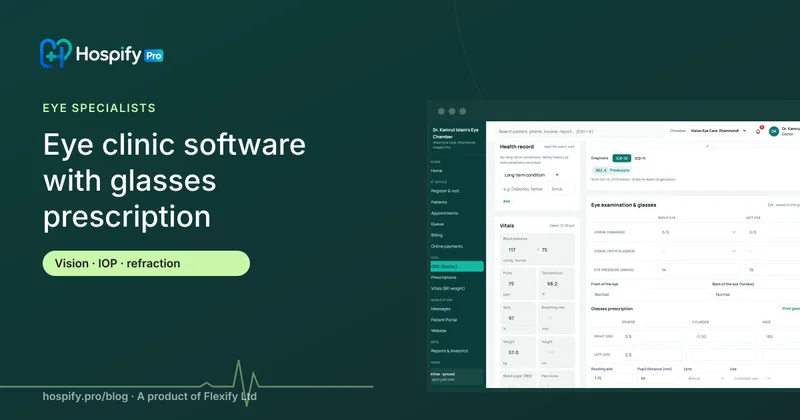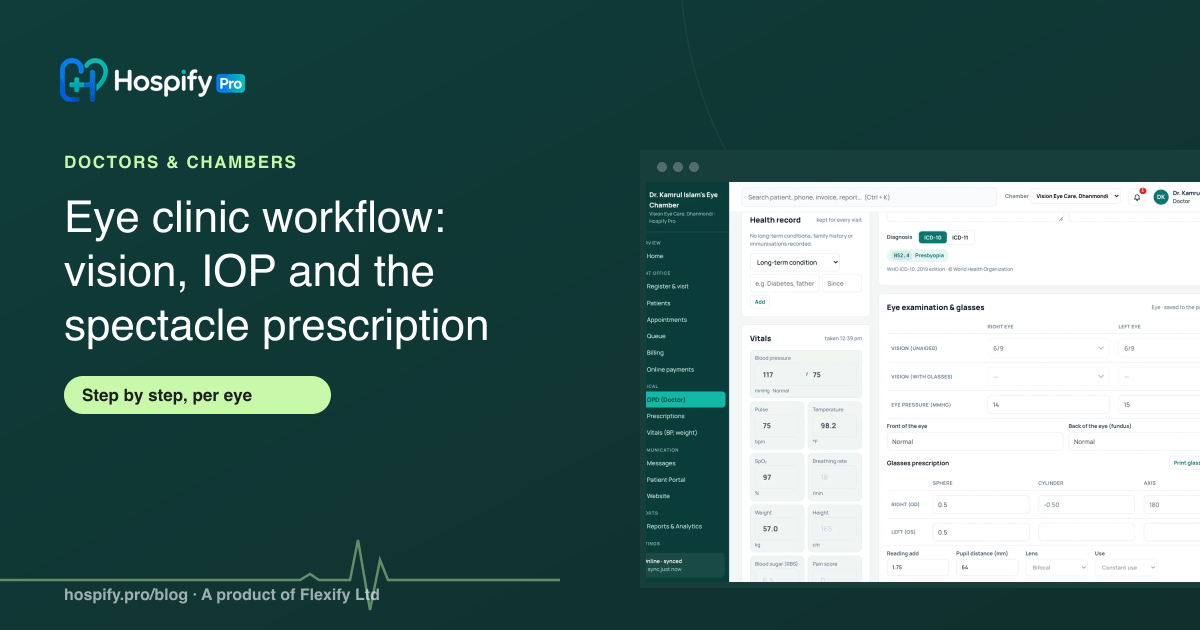
A smooth eye clinic workflow runs in stations: the front desk registers the patient and takes the fee, an assistant records vision for each eye (without and with glasses) and the eye pressure (IOP), the doctor examines the front and back of the eye, then writes the spectacle prescription (sphere, cylinder, axis, add, pupil distance and lens type) and eye drops for the right, left or both eyes. The glasses prescription prints on its own page for the optician, and glaucoma, cataract and diabetic patients get a follow-up date. Eye clinic software that records all of this per eye removes most of the paper and copying errors.
In this guide 10 sections
- Station 1: Registration and fee
- Station 2: Vision for each eye
- Station 3: Eye pressure (IOP)
- Station 4: The doctor’s examination
- Station 5: The spectacle prescription
- Station 6: Eye drops, by eye
- Station 7: Procedures, bill and follow-up
- How Hospify Pro’s eye chamber follows this workflow
- Checklist for an eye OPD
- Frequently asked questions
An eye OPD has more steps than a general chamber, and most of them happen before the patient reaches the doctor. Vision has to be tested, eye pressure measured, and every result written for the correct eye. When this runs on paper, the doctor spends time re-checking numbers, the optician struggles to read the glasses prescription, and patients put drops in the wrong eye.
This guide sets out a simple workflow for an eye clinic or eye chamber, station by station, and what to record at each one.
Station 1: Registration and fee
The front desk finds the patient by phone number or registers them once, then takes the consultation fee and gives the serial.
Ask two questions here, because they decide what happens next:
- Is this a follow-up? Glaucoma, cataract, diabetic eye and post-operative patients come back on a schedule. Their last pressure and vision should be ready for comparison.
- Do they wear glasses? If yes, ask them to bring them to the vision station.
Station 2: Vision for each eye
An assistant or optometrist records, for the right and left eye separately:
- Vision without glasses (unaided).
- Vision with glasses, if the patient wears them.
- Refraction, if your clinic does it before the doctor.
Write R and L side by side on the same line, never on separate pages. “R 6/9 · L 6/18” is hard to misread; two loose slips are easy to swap.
Station 3: Eye pressure (IOP)
Measure the intraocular pressure for each eye, in mmHg, and note the method if your clinic uses more than one. For glaucoma follow-ups, show the last few readings next to today’s, so the doctor can see the trend at a glance.
Station 4: The doctor’s examination
With vision and pressure already recorded, the doctor focuses on the examination:
- Front of the eye (anterior segment): lids, conjunctiva, cornea, lens, for example early cataract.
- Back of the eye (fundus): retina, optic disc, for example diabetic changes.
- The diagnosis and plan, including any procedure such as laser or a referral for surgery.
Station 5: The spectacle prescription
When glasses are needed, write the full prescription for each eye:
| SPH | CYL | Axis | |
|---|---|---|---|
| Right eye | −1.25 | −0.50 | 180 |
| Left eye | −1.50 | −0.75 | 170 |
Then add the reading addition (Add) for near vision if needed, the pupil distance (PD) in millimetres, and the lens type: single vision, bifocal or progressive, and what the glasses are for (distance, near or both). Powers go in steps of 0.25.
Print the glasses prescription on its own page. The optician needs only this table, clearly printed, not the whole prescription with diagnosis and drops.
Station 6: Eye drops, by eye
Every drop needs the eye written next to it:
- Right eye, left eye or both eyes.
- How many drops, how often, and for how long.
- For several drops, the gap between them (for example, 5 minutes).
Writing the instruction in Bangla, for example “ডান চোখে ১ ফোঁটা দিনে ৪ বার, ৭ দিন”, helps older patients use the right drop in the right eye.
Station 7: Procedures, bill and follow-up
Procedures done today, such as refraction or a laser, go on the bill at the counter without retyping. Then give a follow-up date that matches the condition:
- Glaucoma: pressure check at the interval the doctor sets.
- After cataract surgery: the post-operative visits.
- Diabetic patients: the next retina check.
How Hospify Pro’s eye chamber follows this workflow
Hospify Pro’s eye chamber records each station on the doctor’s prescription screen:
- Vision for each eye, unaided and with glasses, and eye pressure for each eye in mmHg, side by side.
- Front and back of the eye findings.
- The spectacle prescription: SPH, CYL and axis for each eye, Add, PD, lens type and use, with powers checked in steps of 0.25.
- The glasses prescription prints on its own page for the optician.
- Eye drops by eye: right, left or both, with Bangla instructions.
- Procedures such as refraction or laser go to the bill when the visit is finished.
- Every visit is kept, so the next visit can compare vision and pressure.
It is part of the Chamber plan at Tk 1,499 a month$24.99 a month with a 14-day free trial. Hospify Pro does not manage an optical shop’s frame or lens stock; it prints the prescription the optician needs. Try the live eye demo, or read our guide to eye clinic software with glasses prescription.
Checklist for an eye OPD
- Patient found by phone number; follow-up patients flagged.
- Vision recorded for each eye, unaided and with glasses.
- Eye pressure recorded for each eye, with the last readings shown for follow-ups.
- Front and back of the eye findings written.
- Spectacle prescription complete: SPH, CYL, axis per eye, Add, PD, lens type.
- Glasses prescription printed on its own page for the optician.
- Every eye drop has the eye, dose, frequency and duration.
- Procedures billed and a follow-up date given.
Frequently asked questions
What is the usual patient flow in an eye clinic?
Registration and fee at the front desk, then vision testing and eye pressure by an assistant or optometrist, then the doctor's examination, then the prescription with glasses and eye drops, and finally billing for any procedure and a follow-up date. Keeping vision and pressure in separate stations before the doctor saves the doctor's time.
Should vision and IOP be recorded for each eye separately?
Yes. Every measurement in eye care is per eye: vision without glasses, vision with glasses and eye pressure are all recorded for the right and left eye. Mixing them up is one of the most common and serious errors, so the form or software should keep R and L side by side.
What goes on a spectacle prescription?
For each eye: sphere (SPH), cylinder (CYL) and axis, plus the reading addition (Add) for near vision, the pupil distance (PD) and the lens type, such as single vision, bifocal or progressive. Powers are written in steps of 0.25. It should print clearly on its own page so the optician can read it without the rest of the prescription.
How should eye drops be written?
Say which eye for every drop: right eye, left eye or both eyes, with how many drops, how often and for how long. Patients often use the drop in the wrong eye when the prescription just says 'one drop 4 times a day'. Writing the instruction in Bangla helps older patients.
Does Hospify Pro manage an optical shop's frames and lenses stock?
No. Hospify Pro's eye chamber records the examination and prints the glasses prescription for the optician. It does not manage frame or lens stock for an optical shop.

Hospify Pro is built by Flexify Ltd for hospitals, diagnostic centres, clinics, doctors and pharmacies in Bangladesh and beyond. Our guides come from the questions owners and managers ask us every week. About us