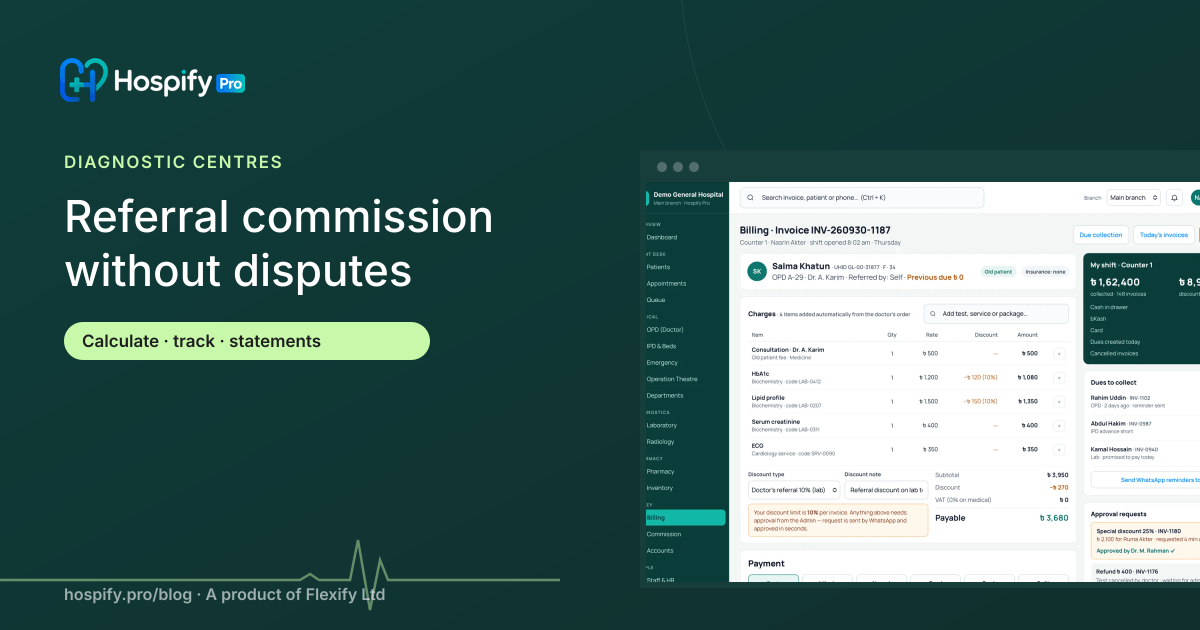
Calculate referral commission by rule, not by hand: set a rate per referrer and per test or category, calculate only on money actually collected (after discounts and refunds), and give each referrer a monthly statement listing every patient and invoice. Software such as Hospify Pro does this automatically from billing, so the commission report is ready on the first day of the month.
In this guide 7 sections
In many diagnostic centres, the busiest day for the accounts team is not a weekday rush — it is the first week of the month, when referral commission is worked out.
Someone goes through a month of invoices, matches each to a referring doctor or agent, applies a rate from memory or a spreadsheet, adjusts for discounts and refunds, and writes a total. Then the phone calls start: “My patient came on the 12th — why isn’t she on my list?”
This guide explains how to calculate referral commission properly, the rules that prevent disputes, and how software turns a week of work into a report that is ready on the first of the month.
A note on compliance. Professional codes of conduct and regulations apply to payments involving doctors, and they change over time. Take advice on the current position, keep every payment transparent and documented, and follow your facility’s policy. This guide is about accurate, auditable record-keeping, whatever arrangements you have.
Why manual commission causes problems
- Missed referrals. The referrer wasn’t recorded at the counter, so the patient never appears on the list.
- Wrong rates. Different referrers, different tests, different rates — remembered rather than recorded.
- Discounts and refunds ignored. Commission is paid on the full price of an invoice that was discounted or partly refunded.
- Unpaid invoices included. Commission is paid on dues that were never collected.
- No evidence. When a referrer disputes the total, there is no line-by-line statement to show them.
- Time. Days of staff time every month, and a temptation to round numbers to make the problem go away.
Every one of these costs money or goodwill. Most are solved by a few clear rules and a system that applies them automatically.
The five rules of fair commission
1. Record the referrer at registration
The referrer — doctor, agent, collection centre or self — must be captured when the patient is registered or the invoice is created. Make it a required field. A searchable list of referrers prevents duplicates like “Dr. Rahman”, “Dr Rahman” and “Rahman sir”.
2. Set rates by rule, not memory
Write the rates down in the system, per referrer and per test or category. For example:
| Category | Default rate | Referrer A | Referrer B |
|---|---|---|---|
| Routine pathology | 20% | 25% | 20% |
| Hormone tests | 15% | 15% | 10% |
| Ultrasound | Tk 200 fixed | Tk 250 fixed | Tk 200 fixed |
| CT / MRI | 10% | 10% | 10% |
Rates can be a percentage or a fixed amount per test. Some tests — like those outsourced to another lab — may carry no commission at all.
3. Calculate on money collected
Commission should be calculated on the net amount actually collected:
- After discounts. If a Tk 2,000 test was discounted to Tk 1,800, commission is on Tk 1,800.
- After refunds. If a test was cancelled and refunded, its commission is reversed.
- Only when paid. If the patient still owes Tk 500, commission waits until the due is collected.
4. Decide who carries the discount
When a referrer asks for a discount for their patient, many centres deduct it from that referrer’s commission rather than from the centre’s share. Whatever you decide, write it down and apply it the same way every time.
5. Give every referrer a statement
A monthly statement should list, line by line: date, patient, invoice number, tests, amount collected, rate and commission — then the total, previous balance and payment. When the statement comes from billing, disputes are usually settled by reading it.
A worked example
Referrer A sends three patients in a month:
| Patient | Tests | Price | Discount | Collected | Rate | Commission |
|---|---|---|---|---|---|---|
| 1 | CBC, lipid profile | Tk 1,800 | – | Tk 1,800 | 25% | Tk 450 |
| 2 | Ultrasound whole abdomen | Tk 1,500 | Tk 150 | Tk 1,350 | Tk 250 fixed | Tk 250 |
| 3 | TSH, FT4 | Tk 1,600 | – | Tk 1,000 (Tk 600 due) | 15% | Pending |
Commission payable this month: Tk 700. Patient 3’s commission (Tk 240) moves to next month’s statement once the due is collected. Done by hand across hundreds of patients, this is where mistakes happen. Done by software, it is automatic.
How software does it
In Hospify Pro, commission is part of billing, not a separate spreadsheet:
- The referrer is selected at the front desk when the invoice is created.
- Rules are set once per referrer and per test or category — percentage or fixed.
- Commission is calculated from collected invoices, after discounts and refunds.
- Dues are tracked; commission is released when the money comes in.
- Statements are generated for any period, per referrer, and can be printed or sent on WhatsApp.
- Payments are recorded, so each referrer’s balance is always current.
- Every change is in the audit log, so nobody can quietly alter a rate or an invoice.
The commission report that used to take a week is ready on the first day of the month. See billing, cashier and commission.
Controlling discounts at the same time
Commission and discounts are linked: uncontrolled discounts reduce both your revenue and the trust in your commission figures. Set discount limits per role, require approval above the limit, and review a discount report weekly. Hospify Pro does all three — more in our hospital software checklist.
Getting started
- Clean up your referrer list — one entry per doctor or agent, with phone numbers.
- Write down your rates per category, and any exceptions per referrer.
- Agree your rules on discounts, refunds and dues — and tell your referrers.
- Run one month in parallel — software and your current method — and compare.
- Switch fully and send the first software statements.
Referral commission is included in every Hospify Pro plan. The full laboratory workflow with collection centres is in the Diagnostic plan at Tk 6,500 a month$149 a month, with a 14-day free trial.
- See Hospify Pro for diagnostic centres
- See the live demo — the real software with sample data, no sign-up
- Book a free demo
Frequently asked questions
How is referral commission calculated in a diagnostic centre?
Usually as a percentage of the test price, or a fixed amount per test, set per referrer and per test category. Good practice is to calculate on the amount actually collected after discounts and refunds, and only for invoices that are fully paid.
Should commission be paid on discounted invoices?
Decide a clear rule and apply it consistently. Most centres calculate commission on the net collected amount, so a discount reduces the commission proportionally. Some reduce the referrer's commission first when the discount was given at their request.
How do we stop commission disputes?
Give every referrer a statement listing each patient, invoice, test, amount collected and commission, with the rule used. When the numbers come from the billing system rather than a notebook, there is nothing to argue about.
Can software handle different rates for different doctors?
Yes. In Hospify Pro you set commission rules per referrer and per test or category, as a percentage or a fixed amount, and the system applies them automatically to every collected invoice.
Is referral commission legal in Bangladesh?
Rules and professional codes of conduct apply to payments involving doctors, and they change over time. Check the current position with your legal adviser and the relevant professional bodies, keep every payment transparent and documented, and follow your own facility's policy.

Hospify Pro is built by Flexify Ltd for hospitals, diagnostic centres, clinics, doctors and pharmacies in Bangladesh and beyond. Our guides come from the questions owners and managers ask us every week. About us