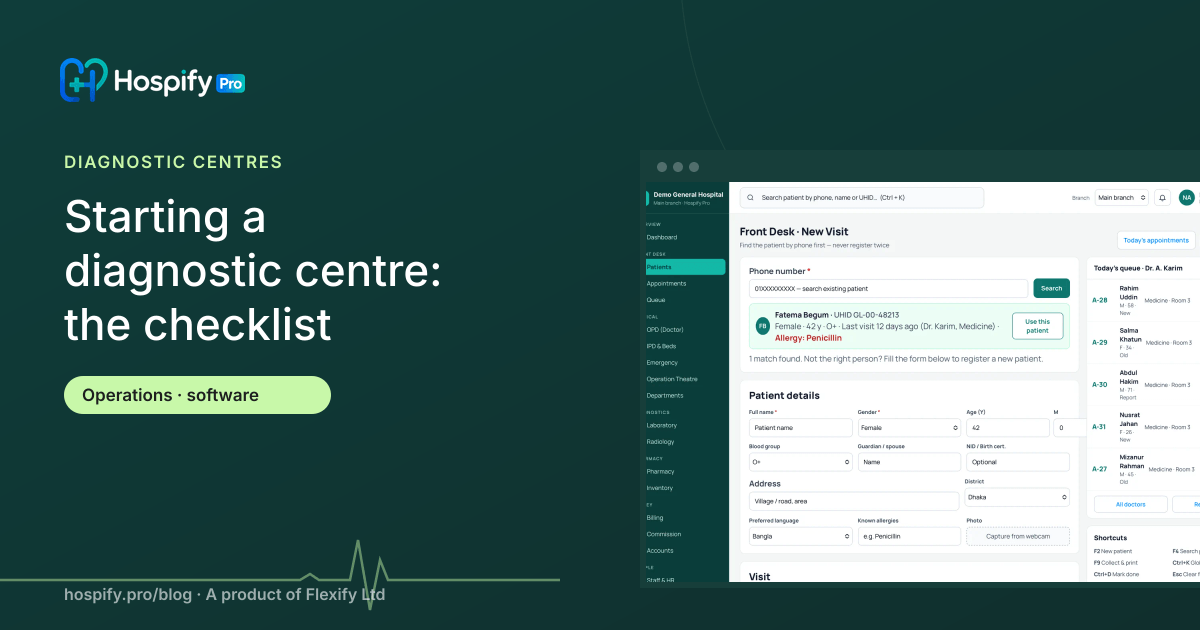
To start a diagnostic centre in Bangladesh, confirm the current licence requirements with the Directorate General of Health Services (DGHS) and your local authority, plan a test menu that matches local demand, hire qualified pathologists and technologists, choose equipment with service support, and set up software for billing, barcode samples, verified reports and WhatsApp delivery before opening day. Run a full dry run with staff before you take your first patient.
In this guide 11 sections
Opening a diagnostic centre is a big investment — premises, equipment, qualified staff — and the first months decide whether local doctors and patients trust you. Most of the hard work happens before the first patient walks in.
This checklist covers the operational side: approvals to confirm, the test menu, people, equipment, the patient workflow, software and the first 90 days.
Note: This is an operations guide, not legal advice. Licensing requirements change. Confirm the current requirements with the Directorate General of Health Services (DGHS), your local authority and a qualified adviser.
1. Approvals and paperwork
Before signing for premises or ordering equipment, confirm the current list of approvals. Typically this includes:
- Licence from DGHS for a private diagnostic centre, which sets requirements for space, equipment and qualified staff.
- Trade licence from the city corporation or municipality.
- Other approvals that may apply — for example environmental clearance, radiation safety approval for X-ray or CT equipment, fire safety, and medical waste management arrangements.
- Tax registration (TIN, and VAT registration where required).
Keep copies of all documents and renewal dates in one place — and set reminders.
2. Plan your test menu
Start with what local doctors order every day:
- Haematology: CBC, ESR, blood grouping.
- Biochemistry: blood sugar, HbA1c, lipid profile, liver and kidney function.
- Urine and stool routine examinations.
- Serology and hormones: common thyroid, hepatitis and other routine tests.
- Imaging and cardiology: ultrasound, ECG, X-ray.
Outsource low-volume or specialised tests to a partner lab at first. Add tests in-house when the volume justifies the equipment.
Set prices that are clear and competitive, and decide your package offers (for example a basic health check-up) from day one.
3. People
- Pathologist(s) to verify and sign reports.
- Radiologist / sonologist for imaging.
- Medical technologists for each section.
- Phlebotomists for sample collection, including home collection.
- Reception and cash counter staff.
- A manager who owns quality, turnaround time and doctor relationships.
Write down who can verify reports and in which sections. That rule goes straight into your software.
4. Equipment and suppliers
- Choose analysers with reliable local service and reagent supply, not just the lowest price.
- Ask whether the analyser supports interfacing to send results directly to your software — see how analyser integration works.
- Plan backup power for analysers and computers.
- Buy barcode label printers for samples and a TV for the waiting-room queue.
5. Design the patient workflow
Walk through a patient’s visit on paper before opening:
- Registration and billing
- Sample collection with barcode labels
- Sample receipt in the lab
- Result entry or analyser import
- Verification and lock
- Report delivery — print, WhatsApp, SMS, portal
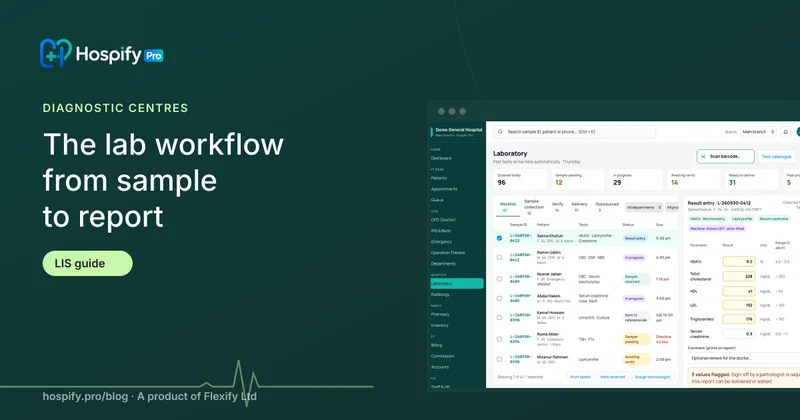
We describe each step in detail in diagnostic centre software: the lab workflow from sample to report.
6. Set up software before opening
Software takes time to set up properly, so start at least two to three weeks before opening:
- Test list with codes, prices, sample types and departments.
- Reference ranges by age and sex.
- Report templates and your letterhead.
- Referrers — doctors and agents — and your commission rules. See referral commission without disputes.
- Users and roles, including who can give discounts and who can verify.
- WhatsApp and SMS templates for report delivery.
With Hospify Pro’s Diagnostic plan, setup, master-data import and online training are part of the Tk 10,000$199 setup package.
7. Run a dry run
Before day one, run a full day with staff playing patients: register, bill, collect, label, enter results, verify, send to staff phones, close the cash. Fix every problem you find. Then do it again.
8. The first 90 days
- Meet local doctors in person and explain your turnaround times and report delivery.
- Deliver reports to WhatsApp from day one — patients notice.
- Offer home sample collection for older patients and busy families.
- Publish your opening hours, tests and prices on a simple website and Google Business Profile.
- Track turnaround time by test every week, and fix the slowest step.
- Review discounts and commission monthly.
Budgeting for software
Hospify Pro’s Diagnostic plan is Tk 6,500 a month$149 a month for 15 users and one branch, including the full lab workflow, radiology, collection centres, referral commission and report delivery to WhatsApp, SMS and portal. Annual billing gives 12 months for the price of 10. See our software price guide for messaging and hardware costs.
Next steps
- See Hospify Pro for diagnostic centres
- See laboratory and diagnostics features
- See the live demo — the real software with sample data, no sign-up
- Book a free demo before you open
Frequently asked questions
What licences does a diagnostic centre need in Bangladesh?
Private diagnostic centres are licensed through the Directorate General of Health Services (DGHS), alongside a trade licence and other local approvals. Requirements and procedures change, so confirm the current list with DGHS and a local adviser before you commit to premises or equipment.
What tests should a new diagnostic centre offer first?
Start with high-volume routine tests that local doctors order every day — haematology, routine biochemistry, urine, common hormone and serology tests, ECG and ultrasound — then add specialised tests once you know demand. Outsource low-volume tests to a partner lab at first.
When should we choose software?
Before opening. Tests, prices, reference ranges, referrers and report templates take time to set up, and staff should train on the real system during the dry run, not on the first busy day.
How much does diagnostic centre software cost?
Hospify Pro's Diagnostic plan is Tk 6,500 a month$149 a month for 15 users, with setup, master-data import and online training for Tk 10,000$199. It includes the full lab workflow, radiology, collection centres, referral commission and WhatsApp report delivery.
How do new diagnostic centres attract patients?
Through local doctors' trust, fast and accurate reports, convenient opening hours, home sample collection, clear pricing, and reports delivered to patients' phones. A simple website with online booking and a Google Business Profile help patients find you.

Hospify Pro is built by Flexify Ltd for hospitals, diagnostic centres, clinics, doctors and pharmacies in Bangladesh and beyond. Our guides come from the questions owners and managers ask us every week. About us